Thursday, October 31, 2013

Fall Break on the Farm

 We wrapped up our second class late last week, which gave way to fall break…or mid-semester break, since it’s not fall-like here. The fifteen of us split up into three smaller groups: one group went south to Kerala, another group went north to Dharmasala, and the group I was in went to an organic farm for a farm-filled break.

The five of us took a cab to the farm, which was only a two-hour drive from Bangalore near a village called Doddaballapura. The paved road we were on turned into dirt and the dirt quickly turned to mud as heavy rains fell the previous night. The driver stopped the car and got out to assess the situation. He said that he couldn’t drive through it, so he pulled the car into a field and escorted us by foot the rest of the way. The thick mud squished beneath our feet and we had one person fall. Luckily, it wasn’t a far walk.

Muddy road
Upon arriving at the farm we met the farmer, Narayana Reddy, who began to talk about his farm and his life after we were served tea. Courtney interrupted him mid-sentence saying, “I think your cow is giving birth.” He kept talking, so she repeated herself. Eventually, he went outside to see what was going on and sure enough. So within the first hour on the farm we saw the miracle of birth. The farmer talked for the rest of the afternoon and gave us words of wisdom such as, “If you want to be happy for a couple hours, get drunk. If you want to be happy for a couple years, get married. But if you want to be happy for a lifetime, become a farmer.” We had some free time before supper. It had begun to storm and I’m fairly certain that lightening struck the property—it thundered so loud that I was immediately given a headache. The power went out, so we all sat in the dark and unfamiliar place and questioned what we were doing here. We walked over to the house around 7:00p and sat in the dark while the farmer talked some more. We ate dinner around 8:00p—rice and a curry made from weeds. We walked back and got ready for bed. I didn’t get much sleep. It was a very strange day.
Momma and baby cow

We went over to the house at 7:00a for coffee. The farmer handed us some small tools and we walked over to a piece of land owned by someone else and began to weed it. I had to be crouched down and hunched over to get the weeding done, but every time I stood up I became dizzy and lightheaded. I kept going. We had breakfast in the field around 10:30a and I was feeling a lot better after food and water. But then it got hotter and I started feeling faint, so I went back to the hostel to recoup. I stayed in the hostel by myself for a couple hours while the others finished up. At this point I just wanted to go back to Visthar. Fortunately, we had a relaxing afternoon and evening. Lunch at 2:00p. Break. Tea at 4:00p. Talk until supper at 8:00p. Sleep.

Day three was the same routine as the day before. I felt a lot better—drank more water, took more breaks. I got some impressive blisters on my hands as well. The farmer left us in the field to finish weeding since he was going to be training a group of 20-some farmers. The farmers stopped at the field first and asked us where we were from and what we were doing on a farm in India. We talked for awhile and then there were some group pictures. We finished weeding around noon. Same routine—break, lunch, break, tea, talk, supper, bed.

The next two days were spent harvesting chili peppers. The land was about 4 km away—a small tractor pulled all of us in a wagon. There were so many chili pepper plants, but more astonishing was the number of peppers on each plant. There were big chilies, small chilies, green chilies, and red chilies. I did a little taste-testing—my mouth was pleasantly fiery. We picked chilies until all the bags were full. We loaded up the wagon and squeezed in for the ride back. The chilies were dumped on the floor and sorted according to color and size. We had free afternoons and evenings, which we filled with reading, writing, thinking, and group bonding.


Taking the tractor through the mud
All the chili peppers
A full bag of reds
Sorting the peppers
The next morning we woke up at 6:00a to the farmer banging on the door telling us that if we got up in the next ten minutes we could milk a cow. We got up and went out to the cow. We were each allowed to milk two squirts. When that was over we went back to the room to wait for coffee. After coffee, we lifted huge bags of chilies onto the roof to dry. There were two people on the ground, two people on a platform, and two people on the roof—we passed the bags up—no machines needed. We had a lot of down time, which I was very much OK with.


Courtney milking the cow
Our last day on the farm was spent picking marigolds. This was by far my favorite task. When you pick a marigold it sounds like popping bubble wrap—so satisfying. We packed up, had lunch, and left only 40 minutes later than anticipated. However, we made incredible time. My head was spinning as we got out of the car at Visthar.

All the marigolds
The farm was…an experience. It wasn’t great, but it wasn’t terrible. I’m starting to be OK with it just being OK. I’m very happy to be back at Visthar. We leave for Zahirabad and Hyderabad on Monday night for course on Environment and Ecology.


Thanks for reading! 
Happy November! 

Sunday, October 13, 2013

Wayanad: A Summary

Our field visit to Wayanad, Kerala marked the start of our second course: Globalization and the Ethics of Development. Here’s a quick summary of the week:

Day 1:
Day one is travel day. We took a 2.5-hour train to Mysore followed by a 4-hour bus ride to Wayanad. The landscape shifted from flat land farmland to forests and rocky hills, which to an Iowa girl look a lot like mountains. We arrived the Rural Agency for Social and Technological Advancement (RASTA), which is where we would be staying for the next few days, in time for supper. The rest of the evening was spent recovering from travel.

Day 2:
The day started off with a delicious spread for breakfast, which to my surprise, included cheese—yum! Our first session of the day was with Omana and Danesh—the founders of RASTA. RASTA is an NGO, which was started in 1984 with the purpose of addressing problems found in rural communities including the oppression of women, indigenous peoples, and small farmers. Our afternoon session was with two different women’s self help groups. The first group we visited was doing work concerning the right to work program. The program guarantees 100 days of employment to each household each year at 180 rupees per day (minimum wage in Kerala). These women organized and petitioned to make changes to the program. Originally, to receive full pay workers would have to work 5 cents of land each day. This was a difficult task, especially for older workers. The self-help group (SHG) was able to reduce the requirement to only 2.5 cents to receive a full days wages. They were also able to change the working hours from 8a – 4p to 9a – 5p, so that they would be able to send their kids off to school. The second self help group we met with appeared to be more general. They saved money and rice each week, which would be put into a pool and redistributed. They also learned skills like tailoring and how to get a loan, so that they would be able to start their own enterprise. The SHG has helped them be more autonomous in their lives. As we were being served tea and snacks, they took the opportunity to ask us some questions about the weather, economy, and marriage practices in the US.

Day 3:
Our day started off with a session with a group of small farmers. They showed us around the farm a bit and gave us a taste of raw tapioca. We climbed up a hill and sat amidst the rubber trees while we asked questions and they gave us answers. When asked about the future of farming, they mentioned that agriculture has no future. There were 7 or 8 farmers that we were talking to and not one had a child who wanted to be involved in agriculture. They talked about farmland being put on the market and being sold for housing developments. After some time, we descended the hill and went inside the house for tea and snacks. They took the opportunity to ask us questions about the government shutdown, the economy in the US, and the American perception of Indian government. In the afternoon we headed out to see the Edakkal Caves. “Edakkal” means “a stone in between,” which describes the way the cave was formed—a boulder in a fissure in the rock. The walls of the cave are lined with wall carvings, which are though to date back to over 5000 years ago. Getting to the cave was a difficult task. It’s about a 30-minute walk uphill on pavement and just when you think you can’t walk up anything more vertical the pavement turns to ladder-like stairs. It was definitely not a cakewalk, but I think it was worth it.  The views were incredible. We descended, which was much easier and then stopped for coffee and homemade fruit and nut chocolate. We went back to Wayanad and stopped for about an hour to do a little shopping.

View from Edakkal Caves

The rock in between

Wall drawings


Day 4:
For our morning session we headed out to meet with two Adivasi women. “Adivasi” literally means “forest dweller” and they are the indigenous people of India. Like the Native American people of the US, Adivasis are a marginalized people. Getting to the village involved steep uphill hiking, however, it was a little less intense than the Edakkal Caves. As we reached the village, a young woman informed us that the two women we were scheduled to meet with were working. She offered to call them in, but Roshen asked if we could talk to her instead since she was already available. She agreed and led us to a large flat rock where we circled up. Her name was Manju and she was 26 years old. It was nice to hear from someone so close in age to us. When she was asked about the relationship between Adivasi people and the settlers it became clear that she was not aware that the settlers had taken Adivasi land—she was under the impression that the settlers were allowing her people to live on their (settler) land. She also mentioned that she watches TV and is aware of global problems. She wanted us to know that she thinks about people in the US and Germany and wonders how we will get through the day when bad things happen. We had a free afternoon and then went to Nazar’s parent’s house for dinner. Nazar is employed at Visthar and does a lot of work at the Bandhavi school in Koppal—Wayanad is his hometown. Once at the house we met the whole family and were served tea and four different kinds of pre-meal snacks. The meal was rice and sambar and tapioca—all delicious.

Day 5:
On our last full day in Wayanad, we visited Balan—an Adivasi activist of sorts. Much of this session was spent talking about the Forest Rights act of 2005, which guarantees 5 acres of land for every Adivasi household. It has been a slow process. Currently, Adivasis in Kerala are asking for just one acre of land so that they at least have some way to sustain themselves. Balan also mentioned other problems Adivasis face such as alcoholism and diseases like sickle cell anemia.

Day 6:
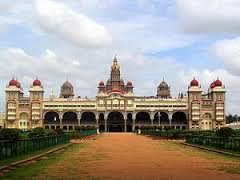
We left RASTA right after breakfast and headed back to Mysore. We saw a wild elephant on the side of the road, which was pretty neat. In Mysore, we had lunch and visited the Mysore Palace. I think this was the fourth palace (at least at this site). The last palace burned down in a fire. The current palace was completed in 1912, so it’s not very old. We did a quick audio tour with headsets. It was beautiful—though the tour was hard to follow. We took a train back to Bangalore and arrived back at Visthar late Friday night.

Mysore Palace (Wikipedia)
Mysore Palace (indialine.com)

Saturday night:
Last night we all got dressed up and went to an Indian wedding—it was more like a wedding reception. I noticed that there was a lot of separated—between the bride and the groom, between female guests and male guests, and between non-vegetarians and vegetarians. It was a Muslim wedding, so most of the food was non-veg. A couple of us who eat veg had to eat separate from everyone else in this small space where we couldn’t see anything or anyone else. However, it was some of the best food I’ve had so far.

SJPD pre-wedding

Thanks for reading!

Saturday, October 5, 2013

One Month in India

I’ve been in India for over one month now. So far most of my blog posts have been a documentation of what I’ve been doing, but the past few weeks I’ve been in class, doing assignments, and writing a final essay for our first course—so not much to document. So I’ve decided to write a more personal blog post about what’s going on with me.

Yesterday, we wrapped up our first class: Identity, Resistance, and Liberation. We had classes on disability, Dalit Resistance, India’s Women’s Movement, Islam, the LGBTI movement, among other things.

The classes are so much different than what I’m used to. No tests—no memorization. Class material is most often presented by outside experts. I’m not drowning in course work, but instead I’m grappling with issues like child labor, poverty, and the oppression of women.

I’ve had a lot of good days, but also a few bad days. Last week was hard for me. There was a lot going on with assignment deadlines, the course essay looming, and a lice outbreak. Feeling stressed left me homesick as well. I was able to Skype my mom for the first time since leaving, which was helpful in lifting my spirits.

One of the things I’m struggling with is balancing my time between being mentally present in India and keeping in touch with people back home. It’s not so much sending emails to my family and friends that I regret, but the time I spend on Facebook scrolling through my news feed, reading status about people who I rarely talk to.

I’ve really missed playing in band and orchestra. I listen to the GWO (Gustavus Wind Orchestra) tour music for Europe quite a bit. I’m hoping that listening to it will make up for not practicing for four months (Ha). However, it is nice to take a break from music. I think it’s a good sign that I miss it.

Time is flying—I can’t believe that I only have 2.5 months left here.
I’m looking forward to seeing what the rest of the semester has in store for me.


Sunday we head to Wayanad, Kerala, which will mark the beginning of our second class: Globalization and the Ethics of Development. 

Expect a long blog post sometime next weekend.

Tuesday, October 1, 2013

Homestay

 Friday evening at rush hour we made our way through Bangalore. The jerks from the stop-and-go traffic, speed bumps, and potholes left me feeling a bit queasy—the smells of the city didn’t help much either. Two hours later we were on the other side of the city. As we entered a residential neighborhood, the bus pulled off to the side and Christina and I got out and made our way into the house to meet the family that we would be spending the next two days with. We shook hands with Athif and then sat down on the couch and made small talk while we waited for his wife, Samitha to return from her parent’s house with their children. Samitha soon returned with her daughter, Nashitha and son, Zaeem.

The kids were quiet at first, though as the night went on they became more outgoing. Zaeem spent most of the weekend at his grandparent’s house, so we didn’t see much of him. However, we did spend quite a bit of time with Nashitha. She asked us all sorts of questions that led us to talk about traffic and lane discipline, sports, school, food, clothing, and holidays. Christina and I offered the American perspective while she gave us the Indian perspective. I tried my hand at explaining Valentine’s Day and the difference between American football and the football that the rest of the world plays—though I’m not sure I did either much justice.

Most of our weekend was spent in the home—although we did get out and see the neighborhood a couple times. We spent our days watching movies and playing games with Nashitha. When we weren’t doing either of these things we could be found perched at the table eating. We had chapatti, rice and sambar, dosas, idli, veg biryani, and so much more. It was all wonderful—I’m going to need to learn some Indian recipes.

All in all, it was a successful weekend. It’s nice to get off campus now and again.

A huge thank you to Athif, Samitha, Nashitha, and Zaeem for being such wonderful hosts and showering us with Indian hospitality.

(Pictures will be posted later.)


Saturday, September 21, 2013

Koppal: A Summary

Here is a long and incomplete summary of the last five days:

Last Sunday night all 17 of us climbed onto a bus with our overstuffed backpacks and matching messenger bags and sat shoulder to shoulder as we made our way toward the train station. We found our platform and watched a few trains go by before it was time for us to depart. It’s a ten-hour train ride to Koppal, which goes by quickly if you’re able to fall asleep.

Arriving in Koppal, we exited the train and made our way to the bus that would take us to Bandhavi—Visthar’s bridge school for girls who are at risk of being dedicated as devadasis—which literally translates to "servant of God." Devadasi women are faced with a lot of discrimination and usually lead lives filled with poverty and abuse. We drove through Koppal and then out to Bandhavi where we ate breakfast and received a tour of the campus.

The first day was rough—three hours of sleep and no coffee would have been more than enough for me to deal with, but the world kept on spinning. We listened to a panel of nine young boys and girls talk about their experiences in child labor, which left us in a kind of existential crisis.

We had an hour of down time before it was time to play with the girls. It was complete chaos. We were outnumbered 106 to 14 and there was a language barrier. But the girls knew what to do. They taught us hand games, cheers, songs, and dances and then we taught them some that we knew. I met Meenakshi that first night. She is in Bandhavi—12 years old and studies 5th standard. We played some hand games and then she stuck by my side the rest of the night—and the rest of the trip. We bonded quickly and easily despite her knowing little English and me knowing virtually no Kannada. She called me akka (older sister) and I called her tengi (younger sister). I even met her mother during our last night. It was hard to say goodbye.
Me and Meenakshi

During our second day, we had a panel with three former devadasi mothers. We accompanied them to a Hindu temple where they did their offerings—though they are not allowed in the actual temple, so they did went to the river behind the temple. They had a ritual bath in the river and then prepared their offerings. We prayed over their offerings and then gave a donation.

Later that day we visited a village—as we rode in, children ran alongside our bus—some climbed on. We got off the bus and sat down on a tarp on the ground. Soon we were surrounded by people from the village—most of whom were children. I have never so many children before. We got up and walked through the village to see a person’s home. As we walked, the children followed. They extended their hands for handshakes, waved, and said, “Hi, what is your name?” A sense of relief flooded over me as we stood in the house away from the children. But as we paraded back to the bus, the mob continued. I began to feel frustrated and overwhelmed. I couldn’t do this anymore. I stopped making eye contact, stopped smiling, and didn’t shake anymore hands. I needed to get back on the bus. But the bus was locked. The children surrounded us and started asking for rupees and pulling on clothing. I was one of the first people on the bus, but those who got on last had a different experience than I did. The children got more demanding and even a little aggressive. In hindsight, the village visit was more troubling than it was as I was experiencing it.

Throughout our time at Bandhavi we worked with the Visthar Community College (VCC) students in creating a photo essay. I was partnered with Devendra. We decided to do our photo essay on nature. We walked around the campus and surrounding area and he took pictures of fields, trees, gardens, vegetables, and animals. We selected ten photos and put them in a PowerPoint. Despite the language barrier, we came up with a thesis, introduction, and caption for each photo. Everyone displayed their photo essay while the Bandhavi girls walked around and looked at them all.

During day three, we went to a school and observed a CREA (Child Rights Education Advocacy) meeting. (CREA is a project of Visthar). There were about 30 kids who sat in a circle in a classroom with only two chalkboards and three barred windows.They started off the meeting by naming some of their rights and then they came up with a list of all the problems within their school: no plates for lunch, no gate around the school, adults gambling and drinking alcohol inside their school at night. They decided that they would wright and submit a complaint in the next few days. I was really inspired by this group of children who were recognizing the downfalls of their school and acting to change them. Previously, they had protested for better teachers and separate bathrooms for girls and boys and their demands were met.

That night, SJPD and VCC went to the Koppal movie theater to see Chennai Express—a short (2.5 hours) Bollywood movie. It was in Hindi—no subtitles. Indian movie theaters are much more interactive than American movie theaters. There were cheers, screams, claps, and whistles throughout the movie. After the movie we debriefed about the experience and how we felt about the item number, the gender roles, and the sexual objectification of women.

We also toured a wig factory during our time in Koppal. To be let in and shown around, we pretended to be a group studying globalization. The hair is collected from village women once each month—they collect their hair as they brush it. In return, they do not get rupees, but small trinkets such as bindis. Women (and children) sat outside on the cement as they picked through the raw hair, lice and all, to get it ready for the next stages. Then it was boiled for further cleaning. Then it was repeatedly pulled through a board with nails sticking out of it to comb through it. Then it was sorted, inspected, and sent off to China for further processing. The end product at this factory was a bundle of hair. The minimum wage in Karnataka is 158 rupees a day. The factory paid women 100 rupees a day while men were paid 200+ rupees a day. Women were doing the dirtier and less valued work. Also, women and men were always separated. Either the women were outside or they were in different rooms than the men.

Our last day in Koppal, we got into our small groups with the Bandhavi girls and did an activity where we drew a picture with this question in mind: “What kind of world do you want to live in?” All five groups placed their pictures around a torch, which was then lit. We all stood in a circle and sang a Kannada song together before saying our final goodbyes and heading back to the train station.


It’s nice to be back at Visthar. This week is packed with classes, documentaries, and presentations. Lots of assignments due as well.

Thanks for reading!

Saturday, September 14, 2013

A Day of Festivals

Festivals are already starting to become a theme in my posts and it's only been two weeks--many more to come. Yesterday we celebrated Onam on the Visthar campus and then we went into Bangalore to observe the Ganesha Festival. 

Onam is a Hindu festival which is celebrated in the state of Kerala (Visthar/Bangalore are in Karnataka). There are many versions and interpretations of the Onam story, but here is the one which I was told:

Mahabali was a well-respected and generous asura (demon) king. The devas (lords), who were becoming fearful of his popularity, asked for Lord Vishnu's help. Vishnu came down to Earth in the form of a dwarf named Vamana and visited Mahabali. Mahabali welcomed Vamana and asked if he would like anything. Vamana requested three paces of land, to which Mahabali agreed. But then Vamana grew to a massive size. With his first step, he covered the Earth. With his second step, he covered the heavens. Having already covered all of the Earth and all of the heavens with just two steps, he asked Mahabali what he should do. Mahabali said that since he promised him three paces, he could take his last step on his head. Before doing so, Vamana asked Mahabali if he would like anything in return. Mahabali requested to be allowed to return to Kerala and to visit his people once each year, which gives us Onam--the coming of Mahabali.

Visthar's very own Mahabali
To celebrate, we processed to the center of campus to the beat of a drum where we met Mahabali. The drum started up again and a few "Hail, Mahabali" cheers were shouted before we continued to the building where the festival was held. Flower petals were arranged in an intricate design on the floor (partially seen above) with Mahabali sitting facing the crowd. Five women dressed in white saris then entered and did a traditional dance before lunch was served.

The Onam feast, sadya, is an entirely vegetarian meal that is served on a banana leaf, with all the vegetables being native to Kerala. Each of the sides is to be eaten with the rice and traditionally there are four helpings of rice, though we were not obligated to eat all four rounds. The following picture I took does not capture the entire meal--food was constantly being served. Not pictured: two desserts, two sauces for the rice, another small helping of rice, and one banana. Traditional games were played after the meal. 


Onam feast--Sadya 


There was enough time for tea between the two festivals. We piled onto a bus and headed to Bangalore to observe the Ganesha festival. My knowledge is very limited, but here's what I know: Ganesh is the god who is represented by the head of an elephant and who brings prosperity and good fortune to those who worship him. 


To celebrate the festival, statues of Ganesh are dunked and submerged in a body of water. Families had small statues like the one in the following picture:


Different communities brought in bigger statues that had to be lifted by crane to be submerged. As you can imagine, there are some environmental impacts from this festival. The statues are made of clay, which dissolves in the water. The bigger statues seemed to have an outer shell of clay and have a structure made of straw. The water used here was contained and separated from the lake though they are thrown into rivers, lakes, and the ocean in other places. Additionally, they were anticipating 150 big statues the night we were there and this festival lasts an entire week--that's a lot of statues.


Throwing Ganesh off the crane platform

This statue brought in by a community was brought in on a flatbed pulled by a tractor. It was so tall that they had to lift up power lines and so wide that it couldn't work with the crane. So tipping it into the water was the next best thing.


Slowly tipping Ganesh

This made quite the splash. The police officer in the picture above took most of the splash for me. Unfortunately, the statue didn't fall far enough into the water. A few men tried to push it further in, but it didn't budge. Then they got the crane going and tried to press it down into the water, but to no avail. 


Push!
As we left the festival, traffic was extremely backed up--to the point where people shut off their engines. The on-coming traffic was made up of tractors and buses pulling huge Ganesha statues. There were maybe ten or so that paraded by as we were stopped. Because it's not everyday you see a bus full of non-Indian people, most communities would wave and cheer as they passed us. Others took pictures, sang, danced, and threw flowers at us. I had a nice little pile of flowers by the time we started moving again. This was definitely the most entertaining traffic jam I've ever experienced.


We leave for Koppal tomorrow evening for our first field visit, so no more posts for about a week.